
Showing posts with label soft skills. Show all posts

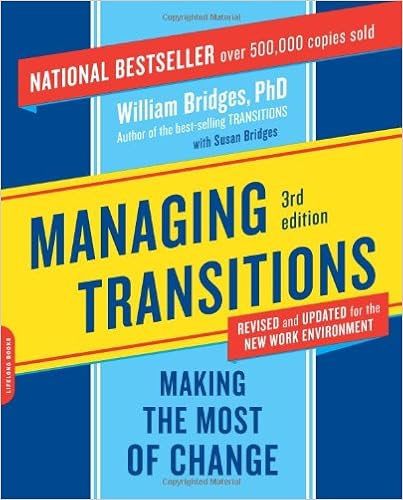
Managing Transitions: Making the Most of Change
By: William Bridges


I liked this book for the most part. The main concept that the book preached is super simple:
Ending -> Neutral Zone -> Beginning
The book dragged on a bit when Bridges talked through lists of tips, questions, and steps to achieve success in these stages, but for the most part these were useful to reference by picking up the book again, rather than memorizing to regurgitate. He did give some great detailed examples at the beginning and end of the book; I wish there were more examples sprinkled throughout like some of my favorite Malcolm Gladwell books. So here is my summary from the book:
  1. Emotions matter: acknowledge them and show them
    • Especially during change, you can feel fear, anger, surprise, guilt, loneliness, or any number of emotional responses. During change you need to encourage people to feel what they feel and not suppress their reactions. Talk about it. Listen and sympathize. And share back. Change is hard and if you can help those around you feel like they aren't doing it alone it will be much easier to make it through it.
  2. Sell the problem
    • Change is happening for a reason. Too many times managers and leaders are too focused on the new and "are we there yet". Your team members are probably a bit behind in accepting it and you need to make sure to spend time on the issue, the why of the change. Only then can people move forward towards the neutral zone and making the transition actually happen... instead of just talking about it.
  3. Change is constant
    • Bridges acknowledged that change often overlaps each other and so having a deliberate end and beginning that happens at the same time for everyone is unlikely. Because of that though, you can encourage innovation and ideas while trying to implement the new change. Of course the something new that is introduced isn't polished and the best method until you start using it so allow for (and expect) tweaks along the way.
Daring Greatly: How the Courage to Be Vulnerable Transforms the Way We Live, Love, Parent, and Lead
by Brené Brown

I loved this book which doesn't surprise me as I loved hearing Brené speak three years ago at a Denver Conference held by the Leadership Investment. Brené is a strong writer that draws conclusions from her research and then tests the theories in her own life and you can connect with her struggles, realizations, and emotions. I let myself take a lot of breaks reading/listening to this to think and apply her ideas to my own life and I must say that she challenged me indirectly. Here are my top three take-aways.
  1. Overcoming the fear of disconnection
    • If you know me in real life, I'm not afraid to ask questions, even in a room full of experts. In the first weeks at my new job, the product team of 30+ reviewed new features and I just raised my hand and asked a what if straight to the developer. That's me daring greatly, but I don't do that all the time and there are definitely times I worry about what other's think of me. Brené offers tips to stay real and accept our wholehearted selves.
  2. Learning shame resilience
    • Emotional hurt can be as painful as physical hurt and so we try to protect ourselves by putting up barriers. The problem is that these barriers keep us from the good things too. I looked at my instinctive reactions when someone is rude, combative, or upset and learned that I usually try to deflect. Maybe your vulnerability armor is different than mine, but learning to identify it is the first step to avoid putting up boundaries and instead embrace the opportunity to be vulnerable.
  3. Being Wholeheartedness
    • "Vulnerability is the last thing I want you to see in me, but the first thing I look for in you." I worry about having kids of my own or managing a team of my own but I have no doubt that both of those things will happen someday. I learned that I should say what I'm feeling more often. Saying it out loud is my challenge to being more honest with others. I think engineers have trouble admitting these so I use a very direct approach "You make me feel _____ right now." but it is better than nothing.
You should read this book to explore your own areas when you put up vulnerability armor to combat shame. Brené says our society is one in which we feel we are "never ______ enough" (thin, rich, smart, etc.) and we need to instead learn that it is okay to talk about it and it is natural to feel that way. Most importantly, it is also not something we should have to face alone! Next time someone wants to open up, don't just let them; encourage them to be vulnerable in a safe and supportive environment.


Here is my version of the good, the bad, and the ugly. A good project manager (PM) has good organization skills and good listening skills, sure, but here are a few things that I think can make or break a PM. The clincher? You can BUY all of these things so it should never be an excuse to stand in your way of going from good to great.
  1. The Obvious: Calendar
    • Every PM needs a good piece of software to do their job and the more people and schedules involved, our jobs become exponentially more complex. (N * (N-1) / 2 in fact). You must have a good calendar that you can move one dependency and shifts or warnings pop up. You must manage holidays and vacation days of your team members too. Pay for the good stuff and you will never regret it.
  2. The Great: Bad Jokes
    • PMs are the ice breakers whether they like it or not. PMs are the bearer of bad news, whether they like it or not. They always find themselves in awkward situations, which is why maybe they are so quirky. So having a back pocket story and funny helps avoid the small talk and anticipating killer silence. And go buy a joke book if you aren't a comedian yourself.
  3. The Annoying: Headset
    • We are people persons and we have to stay well connected. Send email, create videos, write documentation and presentations, call stakeholders. You have to be easy to contact and easy to hear so having a high quality headset is key to being able to refill your coffee or block out the neighbor-cube calls while on the phone.
Happy Monday!

The past few years I've tackled many home improvement projects such as a new furniture, painting, building a deck, installing crown molding, and right now it's building a garden bed. Many of these projects are definitely easier if you have the right tools. (I made a lot of trips to Home Depot...) But really when taking on a project like any of these, it is nice to have a partner to help. But whether that is moving materials, measuring, or deciding between two designs, the kind of help varies. Please, stranger, don't offer to help me load wood into my car. But yes, my aunt can offer to pick the wall color. When should you offer your assistance to someone else, whether you know them or not?
  1. When it looks like someone is struggling
    • The best time to offer an extra hand is when it is obvious that one is needed. Whether it is something too big for them to handle or something new to them, it might be hard for them to do something on their own. Please time your offer to help early on though because if you're asking after two flights of stairs, you'll get a glowering reply!
  2. When you are an expert
    • Even if you don't see someone struggling, you may see a better way for the way they are doing things. You've done it so many times that you can do the activity with your eyes closed. You know an efficient method, a better design, or simply more detail that can help them in the future. This is a great time to offer to help BUT ask first. Make sure that your advice is welcome. They might not have time to listen, the patience to care, or they might really want to figure it out for themselves. Respect that and don't butt in regardless.
  3. When it's polite
    • Asking to help because you think "you should" is not a good reason at all. Sure, chivalry isn't dead, but if you aren't asking because of one of the reasons above, you aren't providing a service, you may be contributing to the problem. Offering to help means you think someone needs your help and so asking out of politeness may come across as rude instead.
I love my job. One reason is getting to be the driving force behind a group's change. You get to know them, you work with them, introduce something new, and turn their old habits into new ones. I think partly why these large changes are so successful is our commitment to the people. And this commitment can only be reached face-to-face. It makes a huge difference to watch their body language, understand their frustrations, and share their smiles of accomplishment. The constant interactions and connections that you make every day while on-site with a client isn't automatic though and if your presence is the one that can make or break the group's change, I have a few tips that can improve your chances of consulting success.
  1. Write down everything
    • Your clients can not only see your facial expressions, but are also watching your actions. They know if you wrote down their suggestion because they either see you jot in your notebook or just take a mental note. Don't underestimate the power of writing things down. Not only will it help you remember it, but your client will gain confidence in you because they see that their thoughts matter. They know you listened because you wrote down their thoughts. It makes them feel like you care!
  2. Ask for local advice
    • If you are on site with a client, you probably are out of town and unfamiliar with the area. Ask the locals for their favorite coffee or food spots, best driving routes, and recommendations on tourist locations worth visiting. This will allow them to share their expertise with you and they feel valuable. Don't underestimate the power of letting your client share some personal experiences. Any discussions about extracurricular activities will boost their self confidence to make dealing with the tough business topics easier.
  3. Always be approachable
    • Sometimes you hover over their shoulder watching what they are doing like a boss. Sometimes you are hunched over with a technical issues at your laptop in the corner. Other times you may be in tense conversations with management over contract costs. In all situations, you must remember that at any time a worker may have a question. They should never have to feel uneasy or hesitant in asking. Therefore, keeping good posture and a neutral expression is important. It may require conscious focus on your part at first but it will make a big difference up and down the chain of command in the long run.
Have you been through an experience in which seeing the other person in-person made all the difference? What was the determining factor that made you walk away afterwards feeling cared for? Was it technical support at Geek Squad versus phone support of Microsoft? Was it having your quarterly review at company headquarters instead of an email? Share what made the real difference!
Dear Family and Friends,
I know I haven't been around as much lately but the truth is it isn't because I don't want to be. Being unemployed is one of the hardest things I've been through and just answering the simple question of "what have you been up to?" or "how are you?" hurts. I don't want to bring you down, I don't want to be reminded of how much my life sucks (because it does, I won't lie), and I don't really have anything else to say. My days consist of job submissions and hope; that's it. I know you are my friends and you support me and want to be there for me but it is hard. So here are a few ideas that maybe can help us have fun together during this period of my life.
  1. Do activities that don't require talking
    • I don't want to hear about your day and you don't want to hear about mine. We can still enjoy each other's company even without the heart-to-heart talks. Sports are a great excuse to get hyped up about the game. Watching a movie is another great example. They allow me to escape emotionally to another world and that really is helpful at times.
  2. Offer to help
    • I never want to take advantage of our friendship for monetary gains and so asking for you to help is not something that I feel is okay. If you want, you can initiate that conversation and break that awkward silence if you really do have a connection that could help. But be advised, you may have a short "I don't want to talk about it" response, or a launch into a rant, so be prepared if you really do want to ask about the job hunt. 
  3. Just wait it out
    • We are still friends and me avoiding you has nothing to do with our friendship at all. I just need some space and will come back like a faithful puppy when it is over. You are the first person I will want to celebrate with!
Thank you for understanding. This troubling time will pass and then we can go out for lunch, stay up late at parties, and share crazy stories about gym hotties or slow baristas. Keep reading by going to Part 3.
I know everyone is writing about the weather this week but I can't help but think of any amount of snow as just an easy "small talk" topic. Where I am in Colorado we had about a foot of snow over the weekend and it is still counting. Personally I love the excuse to cuddle up with a cup of tea. It is also a great way to break the silence in some of those awkward networking events. Filling the void of silence is not always a waste of time and small talk does have its benefits.
  1. Find something in common
    • When in an uncomfortable setting, friendly banter can ease the conversation into something a bit more relevant. You might start with snow as a topic and it might lead to you finding out that your neighbor has a condo on the ski slope that you could rent for cheap. Now you know you both like to ski and you automatically have something to talk about with them every subsequent time you meet inadvertently.
  2. Learn something new
    • Small talk doesn't have to be mindless banter. If you aren't someone who watches the news on a daily basis or not someone that follows Twitter trends regularly, you might actually learn that the Winter Storm Nika is the cause of all the moisture or to watch for the Goldieblox Super Bowl commercial sponsored by Intuit. It might not all be useless facts!
  3. Pass the time
    • Sometimes you simply are waiting out the clock. What about "time flies when you're having fun"? If you really are just waiting until the meeting starts, why not make twiddling your thumbs a bit more exciting and strike up a conversation with some else in the same situation.
Can I recommend that you stretch your small talk skills and initiate a conversation instead of checking your email needlessly on your smart phone? Whether the closest random stranger is sitting next to you on the bus, at the conference table, or in the elevator, try sparking up a conversation and it just might be worth your time. Also, if you struggle with small talk, Debra Fine is a great local speaker and author that can give you some tips!

Follow me on Blogarama