

Showing posts with label book review. Show all posts

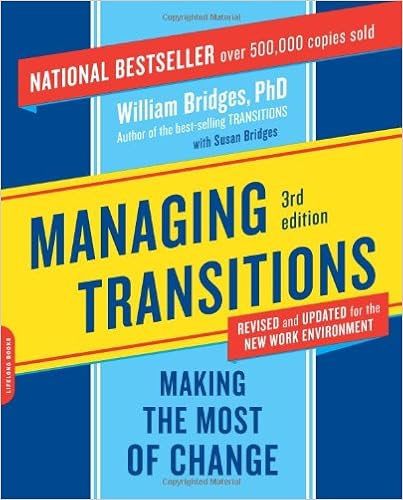
Managing Transitions: Making the Most of Change
By: William Bridges


I liked this book for the most part. The main concept that the book preached is super simple:
Ending -> Neutral Zone -> Beginning
The book dragged on a bit when Bridges talked through lists of tips, questions, and steps to achieve success in these stages, but for the most part these were useful to reference by picking up the book again, rather than memorizing to regurgitate. He did give some great detailed examples at the beginning and end of the book; I wish there were more examples sprinkled throughout like some of my favorite Malcolm Gladwell books. So here is my summary from the book:
  1. Emotions matter: acknowledge them and show them
    • Especially during change, you can feel fear, anger, surprise, guilt, loneliness, or any number of emotional responses. During change you need to encourage people to feel what they feel and not suppress their reactions. Talk about it. Listen and sympathize. And share back. Change is hard and if you can help those around you feel like they aren't doing it alone it will be much easier to make it through it.
  2. Sell the problem
    • Change is happening for a reason. Too many times managers and leaders are too focused on the new and "are we there yet". Your team members are probably a bit behind in accepting it and you need to make sure to spend time on the issue, the why of the change. Only then can people move forward towards the neutral zone and making the transition actually happen... instead of just talking about it.
  3. Change is constant
    • Bridges acknowledged that change often overlaps each other and so having a deliberate end and beginning that happens at the same time for everyone is unlikely. Because of that though, you can encourage innovation and ideas while trying to implement the new change. Of course the something new that is introduced isn't polished and the best method until you start using it so allow for (and expect) tweaks along the way.
The Richest Man in Babylon
George S. Clason

This was a super fast read and in my opinion, is pretty much a masked list of financial saving rules to live by. It wasn't much of a story and not my favorite book. Maybe because I'd consider myself fairly conservative as a spender before this book, but if you're new to being on your own and aren't sure about what retirement planning means at age 22, then maybe you'll enjoy this.
  1. Pay yourself
    • The book's main message is that you can't get rich if you never pay yourself. Too many people go on a spending spree when they have a surplus. What that means is it's gone when it's gone. Instead, you need to pay your future self. You do that by contributing to an IRA, 401k, or other long term goal. Only then, after you've set some aside, should you splurge on that new TV.
  2. Don't overspend
    • It is so easy to spend without looking at the remaining balance these days. Without writing checks or counting cash, the electronic payment world of credit cards, PayPal, and bitcoin is actually quite scary. Layaway is the worst idea ever (IMHO) as you shouldn't take out a loan in any size ($1 or $100,000) that you don't know when you will pay it back. You have to know when you will be back at zero instead of negative! You can't go positive without first passing zero.
  3. Use compound interest
    • Whether it's the risky stock market, points on credit cards, or interest at the bank, you shouldn't be afraid to move around to get the best 0.01% bump. It all adds up! As the book says, "make your money work for you" and have it make money too.
Empty Mansions: The Mysterious Life of Huguette Clark and the Spending of a Great American Fortune
By: Bill Dedman and Paul Clark Newell, Jr.
  1. If you care about something, you'll make it happen to every detail
    • Throughout her whole life (until age 104) Huguette love dolls and doll houses. Not as playthings, but as ornate beautiful pieces of art. She commissioned so many detailed projects and would politely reject things if they weren't right like the width of a door. It doesn't matter what it is that you're passionate about, but it shows when you fawn over every bit of it.
  2. Honestly, it's not the wild west anymore
    • It's sad but true, the world just isn't like the goold ole' days of striking gold in a mine, or banking as an entrepreneur. In the book, Huguette's father first got rich by buying eggs and carrying them across country to winter Montana. The land isn't free, information moves fast, and the economy is global. To become a millionaire, it take a similar brain but a different application. It's tough!
  3. Always be polite
    • One of the things that didn't surprise me in the book is in her old age, Huguette threw money at problems to solve them, even a friend's health. But what was a bit surprising to me in the book was everyone said she was so generous. Not just with gifts of large sums, but even when saying no and sending something back that "wasn't good enough", she was always warm and friendly. I'd like to be remembered that way too.
Lost to Time: Unforgettable Stories That History Forgot
By: Martin W. Sandler
What a fun little book this one was. The 11 short stories made it an easy read to pick up at random times to get a little bit of history. My favorite story was of Alfred Beach, who not only is the father of Scientific American magazine but also of the first American subway - built in secret! Here's a couple inspirational thoughts I got from the book and these forgotten histories.
  1. Always look for the new
    • Keeping up with the trends is tough enough, but being on the front end of the hottest and latest gadgets is where you want to be to capitalize on opportunities. The presidential election, latest cell phone design, or as Ziryab in the book, music and perfume. You've got to stay ahead of the curve if you want to make it into the history books.
  2. Timing can be everything
    • Even if you are ahead of the curve, sometimes you still have a fight ahead of you. If you aren't the latest gossip, than your stories might get lost. From the book, the examples include Peshtigo fire competing with the Chicago fire publicity. Or recently in 2015, Kim Kardashian versus NASA's Pluto pictures. Which do you remember? For good reason!
  3. Document yourself
    • People aren't going to write about you unless you have already done a lot of the legwork. Write down (or video) your experiences, whether as a journal for yourself, a public press release, or social media post, you have to take the initiative. In the book, Gustave Whitehead cared more about personal achievements than publicity around his flying machine and thus the Wright brothers are in our history books and museums. Become a blogger or more today!
Do you love the book reviews on this blog? Curious about what I'm reading next and why? Here is what I am up to so far in 2016.


  1. Lost to Time: Unforgettable Stories that History Forgot
    • I'm in the middle of this one now and it's a fun read with short stories throughout time. Look for my review coming soon!
  2. Seveneves
    • You always need to mix it up! Here's a sci fi book to balance out the heavier reads. I do this in my writing too; to helps me stay creative.
  3. Triggers: Creating Behavior That Lasts--Becoming the Person You Want to Be
    • I loved Marshall Goldsmith's other books so this was a must read for me. I hope to enjoy the stories, lessons, and his flawless writing style.
  4. Wait: The Art and Science of Delay
    • I picked this book in particular for its subject matter on emotional intelligence, I'm always looking for ways to learn patience and improve my business skills.
  5. Empty Mansions
    • Not usually one of my genres, but the national history at my work inspires me to read more in this subject. It's about the American Dream in 1900's with the copper fortunes.
  6. I Am Malala
    • I started reading this last year but haven't finished it yet. I greatly support women's rights across the globe and since Malala's 2014 Nobel Peace Prize and 2015 movie release, I can't say enough good things about her cause for girls' education in Pakistan and human rights beyond.
  7. The Power of Now
    • Recommended by a friend upon my love for the Power of Habit, this book fits into the business category. A hope to find inspiration in it.
  8. Leviathan Wakes (The Expanse Series)
    • The SyFy channel released this as a show in December last year and as a favorite among sci fi fans, I thought I'd give it a try.
Okay, that looks like an ambitious list for 9 months, but we'll see! I think it's a good mix. :-) Have you read anything good lately?
David and Goliath
by Malcomb Gladwell

I really enjoy Gladwell's books because he weaves stories with purpose. In this book he starts with the book's title but goes on to share stories of overcoming challenges in autism, religious views, and fights for human rights. Time and time again Gladwell shows that it isn't the cards you are dealt but how you play them. You can overcome any weakness and turn it into a strength if you make it so.

  1. Momentum is harder to kill than acceleration
    • Struggles or flat out shortcomings as necessary to gain success. In one story, Gladwell interviews people about losing one's parents early in life as a necessary evil in developing key characteristics. Does that mean they wish such horror on anyone else? Of course not! The point is that they learned to keep moving and not only get past the hard part but straight on into success.
  2. Keep your goals above your competition
    • If you compare yourself to your neighbors, you've selected a small data set. Most people believe they're above the average, funnier than they are, and lucky. Don't doubt your efforts because there is something in the way you do things that makes you a David among Goliaths. Gladwell shares stories of college A+ students and basketball winning athletic prowess that sound unthinkable but instead are people that are simply determined and smart placements.
  3. Statistically, once is not never
    • Gladwell tells many stories of greatness and great sorrow. He talked about those that  experienced near death bombings during wartime and how they felt invisible. If you are ever faced what what looks like the impossible or improbable, don't be so sure! There is no recipe for success. Instead of trying to find the cause for success, fight for what you believe in, follow your heart, and try to be that one in the million that proves everyone else wrong.
Daring Greatly: How the Courage to Be Vulnerable Transforms the Way We Live, Love, Parent, and Lead
by Brené Brown

I loved this book which doesn't surprise me as I loved hearing Brené speak three years ago at a Denver Conference held by the Leadership Investment. Brené is a strong writer that draws conclusions from her research and then tests the theories in her own life and you can connect with her struggles, realizations, and emotions. I let myself take a lot of breaks reading/listening to this to think and apply her ideas to my own life and I must say that she challenged me indirectly. Here are my top three take-aways.
  1. Overcoming the fear of disconnection
    • If you know me in real life, I'm not afraid to ask questions, even in a room full of experts. In the first weeks at my new job, the product team of 30+ reviewed new features and I just raised my hand and asked a what if straight to the developer. That's me daring greatly, but I don't do that all the time and there are definitely times I worry about what other's think of me. Brené offers tips to stay real and accept our wholehearted selves.
  2. Learning shame resilience
    • Emotional hurt can be as painful as physical hurt and so we try to protect ourselves by putting up barriers. The problem is that these barriers keep us from the good things too. I looked at my instinctive reactions when someone is rude, combative, or upset and learned that I usually try to deflect. Maybe your vulnerability armor is different than mine, but learning to identify it is the first step to avoid putting up boundaries and instead embrace the opportunity to be vulnerable.
  3. Being Wholeheartedness
    • "Vulnerability is the last thing I want you to see in me, but the first thing I look for in you." I worry about having kids of my own or managing a team of my own but I have no doubt that both of those things will happen someday. I learned that I should say what I'm feeling more often. Saying it out loud is my challenge to being more honest with others. I think engineers have trouble admitting these so I use a very direct approach "You make me feel _____ right now." but it is better than nothing.
You should read this book to explore your own areas when you put up vulnerability armor to combat shame. Brené says our society is one in which we feel we are "never ______ enough" (thin, rich, smart, etc.) and we need to instead learn that it is okay to talk about it and it is natural to feel that way. Most importantly, it is also not something we should have to face alone! Next time someone wants to open up, don't just let them; encourage them to be vulnerable in a safe and supportive environment.


I finished my first sci-fi book of the year and when I learned it was made into a movie I watched it right away. This 2010 movie, Never Let Me Go (which is actually also a song), just didn't live up to the book. There seemed to be so much left out, implied, or communicated in different ways that it was almost distracting. But then I realized, it was very similar to business in items you turn from report to presentation, proposal to pitch. Converting something written to something visual can take concentration and grace. What makes it so difficult to communicate the same content in a different medium?
  1. Time investment
    • It only takes 2 hours or less to watch a movie, but many weekends to finish a book. The same is true for presentations in the compressed time of hours to minutes. Our interest in the ending is built over time, drawn by clues leading us to answers. An fast action-packed film doesn't let us look away, but a poetic mystery may keep us on the edge of our seat when reading. And presentations? Something that doesn't make us crave a nap within 20 minutes is what I call success.
  2. Pictures mean 1000 words
    • When you look at a farmer in a field of dead corn, or a president at a podium with a stern face, or a , you notice little things that set the mood. Cloud cover can bring you down, or a chatty audience can perk you up. With words, such a scene would need pages to describe the detail and set the stage. Color, art, handouts, and gestures can keep people watching you.
  3. Speed of listening
    • Have you ever read a book out loud to someone? It is a very different experience. The speed at which we speak is much slower than the speed in which we listen and think. Influenced only by vocal tones of the reader, your imagination runs wild bringing the story to life in your own perspective. A balance of control, the best listeners take an active role in the story or presentation.

I finally finished Bitter Brew: The Rise and Fall of Anheuser-Busch and America's Kings of Beer and the story of the Busch family, politics, commerce, and more. It was interesting because this truely "American" company is a very strong brand that has evolved over 100+ years before its monarchy ended in 2009 with the InBev partnership. What I enjoyed about the book is the factors that made the company great and their leaders so iconic.
  1. Influence of popularity
    • When your name is synonymous with a brand, you flaunt your money in ways that sometimes seem unethical. Popularity causes crowds of people to flock to you and as a result you feel obligated to keep them there. The Busch family threw parties, built theme parks, and gave away free beer.
  2. Quality above Quantity
    • Beer and other perishable goods must meet very strict demands to taste good and stay fresh. Busch never changed their formula to meet demand and instead stayed true to the fermentation processes and would inspect distributors for old beer past its shelf life. They never compromised on their recipe and it helped them gain loyal drinkers. This enabled Busch to hold a majority market share in the competitive market of beer for years and years.
  3. Trends Come and Go
    • As the company grew and supply chain sped up, Busch branched out to some but not all "comparable" markets like food, baseball, and merchandise. They stuck through Prohibition by lobbying. They didn't join the light beer party until well after it was established. They did make an Australian style lager and hard alcohol options when tastes changed. Knowing your market strategy can guide you to making the best decisions for you and whether or not you should participate in certain trends.
Fame and fortune did a number on the Busch heirs named August (3rd and 4th specifically) and the story really does have a sad end. Partnerships can change your values and change your brand and it has taken its toll on Busch beer. Do you know another brand that has an interested history? Share!

Still Foolin' 'Em: Where I've Been, Where I'm Going, and Where the Hell Are My Keys?
by: Billy Crystal

I just finished listening to Billy Crystal's autobiography at 65 years old and whether a fan of his comedy or not, I enjoyed his book mainly because of how it made me look at my own life. Am I making choices that I will regret later in life? Am I setting long term goals that I can achieve? I took away three big ideas from listening to Billy Crystal talk about himself, some chapters even in front of a live audience:
  1. You don't find real meaning by waiting for someone to give it to you
    • Billy shares the secret of the revelation given to him at his Bar Mitzvah... and things aren't what they seem at face value. People will tell you what they think you should think, how you should act, and how you should feel. If you wait for someone else to determine that for you, you might not get the answer you wanted. Which means, you should just define things for yourself from the beginning!
  2. Death is scary but that means you should talk about it
    • Whether you like it or not, as you get older your friends and family pass away. And it hurts! The fact is everyone is getting older every day and you will never be ready when it is time to say goodbye. Billy tells you to celebrate your birthday every year and even though planning your own demise is strange, just remember to tell your loved ones how you feel as often as possible.
  3. Happiness is not only skin deep
    • Billy loves his family, baseball, and his comedic career of stand-up and movies. You could tell he was happy not because of the fame and fortune, but because he loved doing it and in turn had loving support of friends and family. Overall, Billy's life seems full of good choices and few regrets and I started to admire him for it... until I realized that, well, if I was going to write my own autobiography, I'd want people to remember me that way too: for all the good times. :-) And why not?!
I rented this quick listen audiobook from my local library (via Overdrive). Have you read any good books lately?

Switch: How to Change Things When Change Is Hard
by Dan Heath and Chip Heath

One of my favorite quotes about change is:
“People don't resist change. They resist being changed.” ― Peter M. Senge
This quote rang true in this book in the way it dissects the way people react to change. The Heath brothers break down our self control into two parts: the rider and the elephant (Haidt) in which the Rider holds the reigns and is the leader... unless the stronger Elephant is distracted by something shiny. Thus, to be successful in influencing change in yourself or others you need to learn how to both direct the rider and motivate the elephant in addition to the basic path to reach your long term goals.

There are nine points made in this book, but my favorite three are:

  1. Follow the Bright Spots
    • Honestly, this is a lesson that I didn't implement early on in my career as a program manager. It is easy to listen to the "squeeky wheel" and try to get the nay-sayers on board with everyone else. I wanted a common starting point so we could move as a unit toward software adoption. Instead Switch showed me how to focus on the bright spots, the places your change IS working, the people that already successfully use and advocate for your idea. Ask: how did they get there? What part of the process have you overlooked that is key to adoption? Find what works for the rider and copy and paste!
  2. Shrink the Change
    • If you want to lose 20 pounds, how are you going to do that? Baby steps broken down to such a level of simplicity that it is hard NOT to do things differently. Start by saying no to donuts unless you go to the store and buy them yourself (not free Friday breakroom ones). Start by just carrying the pedometer every day. Don't say no sweets. Don't count calories. A simple checklist (see The Checklist Manifesto review coming soon) can help you realize your goals little by little. As the Heath brothers' say, break it down until it no longer spooks the elephant off course.
  3. Find the Feeling
    • I'm an analytical person and work with technical engineers on a regular basis so even though I know this technique, it still surprises me how influential it is. I am one that truly believes in the power of statistics and examples to sway my audience. The tough truth is that the elephant is motivated by many things and if you can understand how your target audience unintentionally reacts to things you can design ways around it.

One of the reasons I loved this book was because there were so many examples and stories. It talked about the size of popcorn buckets and weight loss, colored vests to prevent medication mistakes, and maps in local food donation drives. A recommended read!


Lean In: Women, Work, and the Will to Lead
by: Sheryl Sandberg


Honestly, I didn't read this book right away because I am already an active feminist. My passion for teaching girl students about STEM, increasing the number of women in technical careers, and supporting women for executive roles is something that I fully advocate for frequently. I know most of the staggering statistics and feel that sharing them with others is important. This is why I love Sheryl Sandberg and what she speaks for. I first heard her at the Grace Hopper Conference and would highly recommend her book if you haven't gotten on board with the lean in movement yet. Hopefully as a man or woman, at home or at the office, it will help you realize what society can gain from challenging the societal gender norms.
  1. Bibliography
    • Even though Sandberg is really only half way through her career, she felt her life story was worth sharing. I love the personal experiences that she shared about meeting the Speaker of the House, making lunches for her kids, and just dealing with her rising fame. It humanizes her to a level that you understand, can sympathize with, and learn from.
  2. Men and Women
    • The hard truth is that women are different from men but we both have our natural strengths. Helping each other and utilizing these gender strengths will get any organization, family, or relationship to grow faster and further then it could on its own. Its been proven. So men, do the dishes and women, sit at the table and stretch yourself to be more.
  3. Solutions
    • You can't do it all. When you are willing to admit to yourself that, then you can make conscious choices and prioritize the things that matter. It is going to be different for everyone so you can't compare your life to theirs. Relax and do your best and be satisfied with your best.
I wrote a post summarizing her keynote back in 2011 and I thought it was worth adding below. These five snippets of advice sum up her book well.
  1. Believe in yourself
    • Women underestimate themselves whereas men overestimate. Women should believe they are the cause of their accomplishments. Quit giving all the credit to your peers – you are awesome.
    • Lean forward. Example: when speakers only take 2 more questions, women’s hands go down after 2 questions, men’s don’t.
  2. Dream big
    • Stereotypes can become true. More women in CS is a reciprocating problem that is cause and effect for more women in CS so dream to make a difference.
  3. Find a life partner
    • This decision is the most important decision of your career. Statistically, women take on more responsibility at home and for kids than men. Consider same sex marriage to equalize the accountability?
  4. Don’t leave before you leave
    • Little decisions that you make in preparation of big decisions later in life mean you've already made those big decisions. You’re not going to go to work and leave the kids at home if you don’t feel valued and that value is usually determined before you have kids. 
  5. Start talking about this
    • Women strive for balance and don’t want to take on new things until they’re ready and feel comfortable. Don’t wait, lean forward and take chances now.
Linchpin: Are You Indispensable?
by: Seth Godin


Can you be irreplaceable even if you aren't a genius? This book argues that with the right attitude, yes, you can. Linchpins are not born they are made and not by following a map or a recipe. There is no defined process of "how to" become indispensable; you have to create your own path.

I agree with Seth's philosophy but honestly I thought the book was lacking. There were no stories of successful people and how they applied themselves to their jobs in new ways. And because there aren't any good stories you could get the same value out of the book by just reading the 200+ chapter headings. Godin almost argues with himself trying to convince the doubters that his movement of thinking differently works. Regardless, the book was fairly motivating and can be summarized in three key points about moving from a white collar button-pushing worker to someone that people talk about and count on.
  1. Make art
    • Artists create and share art which Godin describes as "anything that's creative, passionate, and personal [that] resonates with the viewer, not only with the creator." Rather than paint on a canvas, art can be the way you negotiate a sale or design a business model. If you aren't reading a script and have a reason to share something new, you are an artist and artists are linchpins.
  2. Give gifts
    • Real gifts are given with no intent to receive reciprocation. Gifts are usually thoughtful and purposeful and whether that is your talents, wisdom, or something tangible, gifts make others special. Making others feel that emotional pull without obligation is rare, meaningful, and worth remembering. Indispensable people are not those that rack up a IOU list, they are people that are well connected because they honor the skills of others.
  3. Ship it
    • This book also encourages people to not second guess themselves and to not wait for the perfect moment. The hardest part about creating something new is fighting the urge to take the safe route and wait for someone else to do it first, approve it, or love it before you stick your neck out. Don't let your "lizard brain" fear get the best of you! To be a linchpin you have to not be afraid of mistakes. Pick up the phone, press "send" on that email, stamp the UPS package with your first rev of a product and just do it!
In my opinion you can say you are creative all you want but you need to show it for it to be true and the book could have done a better job in demonstrating who a linchpin is rather than attempting to explain it abstractly. No two linchpins are alike so aren't there tons of examples that we can look up to? Who is someone that you look up to that is an example of a forward thinker that doesn't "go by the book"?
The Power of Habit: Why We Do What We Do in Life and Business
by: Charles Duhigg

Did you know that Target knows when you are pregnant? Or that the memory loss victims in the movie 50 FIRST DATES could psychologically create new habits? This book breaks down the way our brains react to habits and cause us to do things methodically. We do every day things without thinking like the route you drive home, when (or if) you eat breakfast, or what you say when you hang up the phone. Our brains strive to create habits out of everything we do because then it frees up our brain to think about other things. In fact, 40% of what we do is habitual!

Duhigg talks through the habit loop that consists of a cue, a routine action or behavior, and a reward. There are tons of examples in the book, but one of my favorites was the story of how Febreze became a popular product by studying the habit loop of the house cleaning process. Taking habits a step further Duhigg applies the same concepts to noticing cultural patterns such as marketing techniques for selling shampoo. The bubble-filled orgasms in shampoo commercials are actually appealing to our neurological expectation that suds (cue) equates to clean (reward).

If you are like me, you have many bad habits that you want to get rid of. For me, those top 3 are: hitting the snooze button, nail biting, and the non-stop excuses for exercising. This book doesn’t suggest a step-wise solution to start/stop a new/old habit but it does cause you to be a bit more aware of the way you do things every day. I recommend this read: The Power of Habit!


Three Cups of Tea: One Man’s Mission to Promote Peace … One School at a Time
by: Greg Mortenson and David Oliver Relin

How can you change the world? You start by finding something worth changing. This biography of the Eastern adventures of Greg Mortenson sometimes caused me to sit in my car in the parking lot to keep listening to the audiobook. It is an amazing tale of bringing education to rural villages in Taliban territories in the 1990’s and 2000’s. Education can truly change a life and whole societies as noted in my review of Half the Sky. You can hear the passion in Greg’s story of a mountaineer turned entrepreneur in three ways:

  1. It comes from within
    • No two dreams could be more different than walking into Pakistan to climb K2, the world’s second highest mountain, and walking out promising to build a school. Sometimes chance encounters change you for the better and take you to the next step of your life like it did for Greg. Nothing else was causing him to take this challenge except himself and that is the most powerful motivator.
  2. He sacrifices everything
    • Greg has the drive to keep going through every loss I know. He gives up his mountaineering passion; he loses his career, his friends, his love, and pretty much every penny to his name. It is just a heart-wrenching story that keeps you rooting for Greg like a hero.
  3. It strikes a chord with his followers
    • Sometimes you fight alone, but slowly people start listening. When there is a cause worth fighting, all it takes is just one person that is influenced (as Greg learned presenting at an empty auditorium on more than one occasion). That one person then repeats the story to his/her network. It becomes contagious and soon Greg is running a multi-million dollar organization!

Greg’s life story is a true story of overcoming the odds and never giving up. His frugality and perseverance were admirable traits that made his efforts successful. It is hard to imagine how he staying positive through all the difficulties and naysayers. This book left me with a new drive to demonstrate the same passion in my own efforts to “change the world”; no matter what comes my way.
Made to Stick: Why Some Ideas Survive and Other Die
by: Chip Heath and Dan Heath

Did you know that “Nice guys finish last” was a misquote from a baseball manager? A “sticky” idea, no matter if it was intended or not, can help you be SUCCESsful – as long as it still communicates your core values and message. The book gives 5 ways that, combined, can give you the best chance of creating an idea that is made to stick.
  • Simple – How can you tell if something is simple enough to stick? “Perfection is achieved, not when there is nothing more to add, but when there is nothing left to take away.” – Antoine de Saint-Exupery. Define and describe your core message in as few words as possible, maybe with alliteration or something catchy, to find its essence. The authors gave the example: Alien is Jaws on a spaceship. Genius!
  • Unexpected – A great way to surprise your audience is to do a twist on an already sticky and popular quip like “The only constant is change…” (Isaac Asimov). Knowing the knowledge base of your audience is key to surprising them. Humans know what the color blue is and what bubblegum tastes like so when a girl in Charlie and the Chocolate Factory turns blue from roast beef flavored gum, we remember it!
  • Concrete – To be concrete you need to keep to the facts. A goal of being the “best” or “most efficient” can mean different things to different people. Using words like “bigger than Google” or “99 cents cheap” however creates common ground. Many times putting yourself in someone else’s shoes helps you understand what concrete data means the most to your customers or your manager.
  • Credible – Being specific with statistics is not always enough. To get people to believe that your story applies to them and their situation, you need to break down the facts into something that can be grasped. The authors recommend the Sinatra Test of “If I can make it there, I’ll make it anywhere.” So give one plausible example, whether negative or positive, that makes the audience believe your credentials are true for any situation.
  • Emotional – We are all too familiar with the “What’s in it for me?” question so make it a habit to get them to care before they ask for it. This was an interesting chapter because it rejected Maslow’s hierarchy of needs. Money is not always a motivator and neither is self-interest so evoking a memorable feeling may be more difficult than you think!
  • Stories – Everyone knows the Jared and Subway story and knows how a powerful story is worth repeating. The authors provide 3 types of plots that work well: challenge (near impossible “David and Goliath”), connection (building an unusual “Romeo and Juliet” relationship), and creativity (involve the listener in solving an “Indiana Jones” puzzle).
Not only is this a great book with decent recommendations of how to make something stick, but the book itself is a great example of something sticky. The book is filled with a simple “sticky” concept, capable applications, well-known brand examples, heartfelt questions, and stories in every chapter. I’d recommend this book to anyone seeking something to spruce up a presentation, document, or task.

Half the Sky: Turning Oppression into Opportunity for Women Worldwide
by: Nicholas D. Kristof and Sheryl WuDunn


What is the greatest untapped resource? Women. Did you know that the US is 68th in the world for the number of women that hold political seats? Want to know which country is #1? Rwanda – at 56%. This book is filled with personal gut-wrenching stories of the oppression of women and the terrible health and education conditions that these cultures face: gender discrimination, sex trafficking, forced prostitution, honor killings, child marriages, etc. I honestly almost stopped reading after the first chapter, and then again hearing about fistulas, but I found myself mesmerized by the passion these women have. Each story is about how one woman fights for her basic human rights and goes to school, learns to read and write, meets with other village women, starts a business, and begins changing village culture.

The reason I like this book is because it argues that the number one way to solve poverty in these struggling nations is education, specifically girls’ education. By educating women, they gain the confidence to become acting member of society and they start handling family finances, practicing family planning, putting children’s health first, and increasing the GOP by contributing to the economy. Success comes more from these internal grassroots movements and by getting involved in small ways like funding micro-finance programs, writing your congressman, or get inspired and read (or listen to the audiobook) Half the Sky, or to watch the PBS special including testimonials of Hilary Clinton, Eva Mendes, Meg Ryan, and more.

What can you do in the next 10 minutes to help? Click here to see about how you can travel, donate, volunteer, or simply spread the word!

Oh, and make sure to take advantage of your own rights and VOTE!

Follow me on Blogarama