
Showing posts with label people management. Show all posts

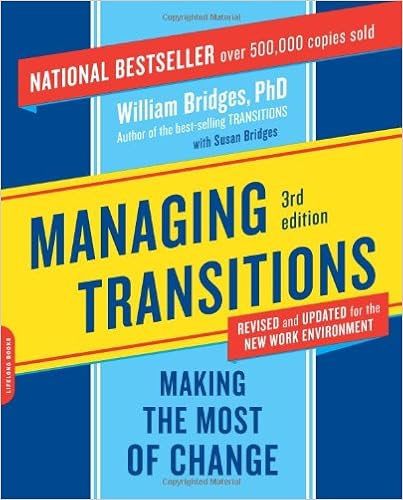
Managing Transitions: Making the Most of Change
By: William Bridges


I liked this book for the most part. The main concept that the book preached is super simple:
Ending -> Neutral Zone -> Beginning
The book dragged on a bit when Bridges talked through lists of tips, questions, and steps to achieve success in these stages, but for the most part these were useful to reference by picking up the book again, rather than memorizing to regurgitate. He did give some great detailed examples at the beginning and end of the book; I wish there were more examples sprinkled throughout like some of my favorite Malcolm Gladwell books. So here is my summary from the book:
  1. Emotions matter: acknowledge them and show them
    • Especially during change, you can feel fear, anger, surprise, guilt, loneliness, or any number of emotional responses. During change you need to encourage people to feel what they feel and not suppress their reactions. Talk about it. Listen and sympathize. And share back. Change is hard and if you can help those around you feel like they aren't doing it alone it will be much easier to make it through it.
  2. Sell the problem
    • Change is happening for a reason. Too many times managers and leaders are too focused on the new and "are we there yet". Your team members are probably a bit behind in accepting it and you need to make sure to spend time on the issue, the why of the change. Only then can people move forward towards the neutral zone and making the transition actually happen... instead of just talking about it.
  3. Change is constant
    • Bridges acknowledged that change often overlaps each other and so having a deliberate end and beginning that happens at the same time for everyone is unlikely. Because of that though, you can encourage innovation and ideas while trying to implement the new change. Of course the something new that is introduced isn't polished and the best method until you start using it so allow for (and expect) tweaks along the way.
You know the feeling. You're in charge, at the center of the universe, and you're lost. You're project has derailed. You don't know what the next move should be but you can't let your peers know that. There is a science to getting yourself and your team back on track. Here's 3 steps to get you started.
  1. Stop what you're doing
    • You're obviously not doing something wrong. If the project is not on track then that's a pretty good indicator that your future plans (that follow the same thought process) are also going to get derailed. Don't try to doggy-paddle and fix along the way; pause everything before continuing!
  2. Look around you
    • When a door closes, a window opens, right? The obvious and easy path is no longer available but you do have options. Take a look, ask around, and reassess the situation. You'll be able to determine the best next step - you're a star Project Manager, right?
  3. Make a list
    • Take inventory and redefine your critical path. Just like a itinerary on vacation, there is a set time on the shortest route to get from point A to point B on a map. Okay, you want to take a scenic detour but know that if you're rained out one day and have to make up time, that optional route is nixed. Projects are the same way; know the fastest way to completion, even if you aren't taking it right now.
Are you a micro-manager? Maybe you read my last post and thought, "Is that me?". Maybe it is a good time to reflect and determine if it is. I want to however clear up some confusion about micro-managers versus simply being detail-oriented. Making sure no rock goes unturned and everything is given attention, detail-oriented people great for making a project go from good to great.
Here are some defining characteristics about detail-oriented people that do NOT mean you are a micro-manager.
  1. You review things on your own time
    • Okay, so you care about every detail, almost looking for mistakes. It's a lot of work, sifting through all of the little things to make sure it's all right. If you take the time to do so, and not just gravitate towards "omg there's an issue; fix it fix it right now" then you're probably okay. Micromanagers may act like a bird that pays most attention to the shiny things in front of them. Show them you respect their time and look at everyone on your own first.
  2. You ask questions
    • Instead of simply changing something, it is better to learn the reasoning that someone did it the other way in the first place. You ask questions like "why" and "how come", or even "does that mean". Even "what about this alternative" is a good sign that you are trying to find the root of the problem and are being a sleuth, not a micromanager.
  3. You accept the corrections of others
    • When you're pointing out the mistakes of others, is it with the intention of making sure it's right? You probably are equally accepting when mistakes are pointed out to you then and you're happy to make the correction whether yours or theirs to make it right. Micromanagers tend to defend their decisions too quickly instead of trusting others.

I can't take the "On this bullet you need to change this word to this one instead." micromanaging conversations. Seriously, who can learn to do something better next time if all the feedback you get is at the "capitalization of a letter" level? Don't you want to just tell micromanagers to just go do it themselves if they think their way is better?

Micromanagers are tough to work for and it takes tact to "manage up". There are definitely rude signals you can try to send them but they never seem to work. And I'll admit, in my past I have tried showing disinterest by leaning back in my chair, avoiding eye contact or interrupting. When someone is focused on the details, they can't get their head above the weeds to notice let alone change their methodology. Micromanagers just keep on going, line by line, slide by slide, not giving any notice to the obvious signals of "stop micromanaging me! It's not working!".

So what else can you do? Try to feed your micromanager's need for control by handing them micromanaging opportunities so that they stay away from the other things. Here are few ideas I've tried that may work for you too.
  1. Tell them
    • I'm serious, tell them they have a problem. Usually they already know about it. Really. They know they have room for improvement but like any unconscious bad habit, it is hard to fix it. Work with them on creating a secret signal to notify them when something is going wrong. Ask them what they think was done well instead of what needs to be fixed. Or, (my favorite) tell them they can only ask questions instead of statements.
  2. Give them control in other ways
    • It is obvious that having both hands on the problem is what it takes for micromanagers to feel they are making a difference. Before they come to you asking for trouble, I mean, asking to help, you can offer first. Give them something to pick apart that isn't your pride and joy or main project. Or give them a task that only they can do like asking his/her boss for something that benefits your both.
  3. Act it out
    • Try to put yourself in their shoes and imagine what it would be like to manage you. If you pretend to be the boss, would you also micromanage? Maybe you can learn a quirk of your own that is triggering your boss's micromanaging. If your boss just acts like the angry receiver of news instead of warning you about them, you learn faster.
I hope that helps! Good luck!
It's a trick question. There is no one that should stay past 5 o'clock in my opinion. Not small business owners, not "omg it broke and I'll get fired if I don't fix it" and not you. If you can't seem to leave on time, it means you have a problem and the solution is not staying later. Guess what, no matter when you leave, when you come back the next morning, you are going to pick up EXACTLY where you left off!


  1. The people that can't delegate or say "no"
    • Whether you're a manager or a team member, you're taking on too much work. You need to learn how to say no, I can't take on more and admit your limits. Even if it's a client, there are things like process documentation or change management communication that you can ask them to help with. People usually are team players and will do what they can.
  2. The people that can't manage their time
    • Who do you ask when you get stuck if you're the only one in the office? If you wait to ask key questions, test critical components, or . If you're on step 5 at 3:30pm and get all this work done until you need the password from the IT guy at step 20 at 7:00pm, guess what, you're stuck. S/he went home and if you had just looked ahead to see the bottlenecks, then you wouldn't have wasted your time.
  3. The people that can't set realistic expectations
    • If you work too much you're probably afraid of under delivering but the culprit may be over promising. I know I struggle with this one when something is needed you want to jump on it right away and give a deadline. At first it sounds realistic, but after a couple hours you find out just how difficult it is. Try saying "Let me get back to you in x hour/days on that" after you've done a real analysis. Then you and all parties involved won't be holding their breath.
I wish I knew who introduced the idea that team building activities would solve team problems. It just isn't an easy or fast way to build relationships with your coworkers or mend past tussles. What these activities are good for is for new teams that don't know anything about each other. You don't need to spend tons of money. My advice is to just borrow from your kid's classroom! There are tons of games and activities that can be reused in the board room.

  1. Apples to Apples
    • Many people are fans of the adult version Cards Against Humanity but for a PG version for work, pull this one out! Getting people to laugh and learning what makes them laugh is a great ice breaker! And it has no time limit so everyone can get a turn and you can end at any time.
  2. Puzzles
    • You can learn a lot about someone's thought process by watching them solve fun puzzles. Whether a brain teaser, riddle, or cardboard puzzle pieces, it exercises the brain as well as your people skills with little stress of "being wrong". It's almost a guessing game and giving people an avenue to participate without being judged.
  3. Physical Activities
    • Our team has gone to a cooking class, done curling, hiking, etc. You don't have to go that extreme; there are lots of simple games that involve moving. Here are some, or more here, and one of my favorites if you have the setup time is here. I mean, seriously, who doesn't like a good game of Red Light Green Light? Video ideas here too.
A fun twist for the end of the game for those of you playing Applies to Apples? If you keep "score" with the green cards, read them at the end and the cards describe the player that won them! Haha.
It's review season! That means it's time to list all of your accomplishments and make yourself look good to your boss so you can get a raise. Then, so you can prepare for the same glowing review next year, you have to review all the times you screwed up so you don't repeat your mistakes. Here are some real world lessons I learned this year. I hope they can help you learn too!

  1. Not everyone loves an optimist
    • I like to tell people when they do a good job, have a good idea, or point out my own mistakes. I think a positive attitude is one that not only keeps spirits up but also allows you to move past difficulties. In my mind, optimism leaves doubt behind and so you can focus on new problems at hand and not dwell on the past "what if". There can be situations in which people aren't ready to move forward quite yet and you need to let them sulk for a bit before they can look on the bright side.
  2. The questions to ask first to play it safer
    • If you're expecting one answer and get another, it can totally throw you off your game so much that it shows on your face and the people around you will notice. Not always a good position to be in if you're trying to provide confidence. If there is something that seems a little off, ask a more general question that requires a story answer. Instead of asking "why did you do this" instead ask something like "what did you do" before hand. Then you aren't putting words in their mouth.
  3. Be even more patient
    • This one is something I constantly strive for. When you know the answer, or have better things to do, or have something to say also, it is so much better to just wait your turn and actively listen. You will gain so much more respect and they will listen in return so much better if you can be patient!
Daring Greatly: How the Courage to Be Vulnerable Transforms the Way We Live, Love, Parent, and Lead
by Brené Brown

I loved this book which doesn't surprise me as I loved hearing Brené speak three years ago at a Denver Conference held by the Leadership Investment. Brené is a strong writer that draws conclusions from her research and then tests the theories in her own life and you can connect with her struggles, realizations, and emotions. I let myself take a lot of breaks reading/listening to this to think and apply her ideas to my own life and I must say that she challenged me indirectly. Here are my top three take-aways.
  1. Overcoming the fear of disconnection
    • If you know me in real life, I'm not afraid to ask questions, even in a room full of experts. In the first weeks at my new job, the product team of 30+ reviewed new features and I just raised my hand and asked a what if straight to the developer. That's me daring greatly, but I don't do that all the time and there are definitely times I worry about what other's think of me. Brené offers tips to stay real and accept our wholehearted selves.
  2. Learning shame resilience
    • Emotional hurt can be as painful as physical hurt and so we try to protect ourselves by putting up barriers. The problem is that these barriers keep us from the good things too. I looked at my instinctive reactions when someone is rude, combative, or upset and learned that I usually try to deflect. Maybe your vulnerability armor is different than mine, but learning to identify it is the first step to avoid putting up boundaries and instead embrace the opportunity to be vulnerable.
  3. Being Wholeheartedness
    • "Vulnerability is the last thing I want you to see in me, but the first thing I look for in you." I worry about having kids of my own or managing a team of my own but I have no doubt that both of those things will happen someday. I learned that I should say what I'm feeling more often. Saying it out loud is my challenge to being more honest with others. I think engineers have trouble admitting these so I use a very direct approach "You make me feel _____ right now." but it is better than nothing.
You should read this book to explore your own areas when you put up vulnerability armor to combat shame. Brené says our society is one in which we feel we are "never ______ enough" (thin, rich, smart, etc.) and we need to instead learn that it is okay to talk about it and it is natural to feel that way. Most importantly, it is also not something we should have to face alone! Next time someone wants to open up, don't just let them; encourage them to be vulnerable in a safe and supportive environment.


Okay, so you're not a manager of any kind. There are some employees that stand out. You notice them. You know who they are and for a good reason. I think there are three types of employees that take the word "worker" to a different level.
  1. The Cheater
    • Knowing how to cut corners is not a bad thing! It demonstrates that you know how to be efficient. It means you know what to spend your time on and what is a waste of your (and other people's) time. These employees help let you know when to "not worry about it" and that's great for saving time and saving money!
  2. The Suck-up
    • There is the "friend" of the office and that's not a bad thing! When someone knows what is going on in people's private lives, knows what the strengths of each person is, they are the only you go to when you need something. They can help walk you over to the person you need and schmoose them a little bit to work for you.
  3. The Juggler
    • Oh the multi-tasker! You have so many things going on that you are on every project under the sun but that's not a bad thing! When you need to know something technical, they likely know the answer because they've done it at least once. They get s*** done! The tough part will be getting on their calendar but they do love to help out.
I say if you aren't one of these people, you should find a new job. If you aren't one of these people you are simply going through the motions and only doing what is in your job description. You are bored and you aren't going above and beyond. You don't have to be the best at everything, but you do need to have (and show) the passion that you have for your team and/or your job. P.S. That doesn't mean stay late.
What about the Secret Agent type?


One of the age old difficulties of working with other teams outside your own is that they have no prior context of your abilities. There is no trust built and even though you are working together, you aren't on the same team yet. How can you bridge that gap and help them feel confident that you have their best interests in mind and want to get the best outcome together?

There are a couple tactics that I have in mind, but there is no tried and true method yet. What do you think?
  1. Make them feel smart by proving you're not always smarter
    • Okay, that's a little strong but when you're in the midst of change, everything is running a mile a minute in your head. We forget the simplest things. We rush around trying to get too many things done. You need to slow down. Don't always blurt out the answer or say, "here I'll just do it for you". They know the answer, let them get to it at their own pace.
  2. Make them feel like leaders by praising their ideas
    • Everyone loves hearing "good job". They like knowing their hard work is noticed and their efforts are worthwhile. As leaders, you have to be a thought leader. It may be your job to work out the details of how to make that idea possible, but make a point to say "that's a good idea".
  3. Make them feel in control by giving them easy decisions
    • When I'm doing a training session, I am the trainer and the one in charge of the schedule, attendance, and making sure that everyone learns something. It can make managers of that team uneasy. Give the manager a say by asking yes/no questions or letting them choose between three choices in some of the activities. If you give them ways to contribute they won't try to bulldoze your control during the actual training. A good example is asking them who should/shouldn't attend certain session together. Use their social knowledge to make your job easier.
A couple weeks ago, I posted about three key tools that every project manager needs. Being a people managers is tough as a lot of your needed skills are soft skills and are hard to learn, buy, or teach. I do think however that there are a few that every manager must have. I think these few things help "boss" become "leader" and so that a people manager can connect on a personal and genuine level with their team.

  1. The Hard: Feedback Phrase
    • Whether required annual reviews or weekly one-on-one time, you need a way to give and receive feedback. You can ask for it simply and directly but it is rare that you'll find subordinates that feel comfortable enough to actually say something valuable. What I've learned is you need something to coax it out of people. It can be a phrase that puts them at ease, the delivery, or the candor that you create but it has to be yours and it has to be genuine.
  2. The Clever: Email filters
    • If you're a manager, you get a lot of email and if you want to get anything done the hard truth is you can't read them all. In Microsoft Outlook (and Gmail and other email providers) you can create rules that filter and place emails into organized folders. If you do it right, you can keep your inbox to only those that require responses. If you don't have the expertise yet, here's a quick video.
  3. The Silly: Favorite Restaurant
    • No joke, everyone has a favorite spot and if you can share it with others and show them why it's your favorite, you've got instant comradery. Our team did a team dinner at an Italian place once before a client visit and another time we did a cooking class. It was awesome and it was years ago but we all still have photos on your desk with genuine smiles.
There are a lot of star quarterbacks hurt this football season already: Luck, Roethlisberger, Romo. Here's to hoping that they get well soon! What I think is special about football teams is that these injured players are always on the sideline. They don't miss a game, stay at home, or become a lesser part of the team. It makes me think of my own two teammates that are out on maternity leave. They're promising to return to the game as valuable players again too! Here's some thoughts I have on why we should keep the sidelined, benched players.

  1. Morale
    • It's tough enough to not have them playing next to you, don't ship them off entirely! Changing the game can have emotional consequences so keep the team spirit together by keeping the benched players engaged. Make sure to continue including them in your team email announcements and locker room pep talks and keep them as active as possible.
  2. External perspective
    • You can still learn a lot by watching instead of doing. You can see the blitz coming in a whole new way. You can watch the competitor's coach making calls on the sideline. You can think about "what would I do" in a whole new way. For maternity leave, you demonstrate work-life balance and that you can (and should) take time off for your family and it doesn't ruin the football season (or financial quarter).
  3. Relevant related skills
    • Even if you aren't actively engaged in the daily grind, there are ways to stay relevant in the industry. Instead of lifting weights or going on business trips you might have more time to attend conferences or read. You know you're coming back soon so use your time wisely and brush up on industry standards or competitor tricks of the trade.


We've all dealt with a micromanager in our lives so I know I don't need to preach to the choir on that one! But what I learned the past week is that the opposite of a bad micromanager as a boss is a good micromanager as a new hire. I have spent the last few weeks training a new team member and she has been doing a great job learning our software. People say you "drink from the fire house" but really the first few weeks is all you need to determine whether you have yourself a good new hire or a tough one. The more they take the initative the better and so the more they micromanaging their learning the better. Here are three things that can help you be classified as "great" too.

  1. Ask "What does this do?"
    • The fact that she doesn't ask me general questions of "What do I do next?" is great! She likes to learn by trying things and practicing hands-on which means she finds things and then asks specific questions about why a feature acts that way, how something gets to a next step in the process, or what this button does. They are specific questions!
  2. Check in every hour
    • I know, training webinars are the worse and waiting for access to every server is a pain. So don't just sit around! When you check in every time you get bored, it means you hate being useless. It sends a good message that you don't like to waste anyone's time, yours or the company's. Even if it is just shadowing something irrelevant, you can learn way more than waiting for permission to work.
  3. Make changes that extend your timeline
    • Oh, micromanagers love to change the font, move a button a quarter of an inch to the right, or name a file differently. But for a new hire? They have to learn somehow! Sure it will take them 3x longer than you to do something, but if they are offering to help than you should be gracious for it. Let them help and learn at the same time even if it isn't exactly the way you'd do it (aka, don't micromanage back if you can help it).
Being a micromanager of your tasks at a new job and trying to learn all the minuscule details of how the senior team members do it so well is a good thing, don't you agree?
Follow me on Blogarama