
Showing posts with label emotional intelligence. Show all posts

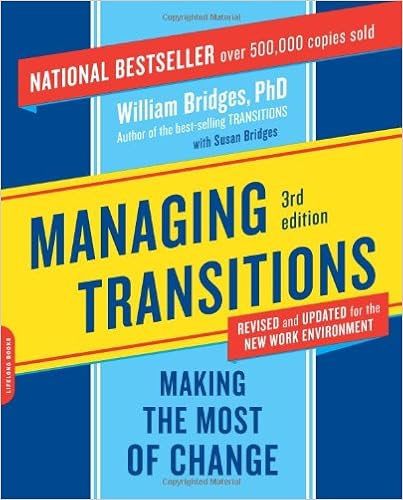
Managing Transitions: Making the Most of Change
By: William Bridges


I liked this book for the most part. The main concept that the book preached is super simple:
Ending -> Neutral Zone -> Beginning
The book dragged on a bit when Bridges talked through lists of tips, questions, and steps to achieve success in these stages, but for the most part these were useful to reference by picking up the book again, rather than memorizing to regurgitate. He did give some great detailed examples at the beginning and end of the book; I wish there were more examples sprinkled throughout like some of my favorite Malcolm Gladwell books. So here is my summary from the book:
  1. Emotions matter: acknowledge them and show them
    • Especially during change, you can feel fear, anger, surprise, guilt, loneliness, or any number of emotional responses. During change you need to encourage people to feel what they feel and not suppress their reactions. Talk about it. Listen and sympathize. And share back. Change is hard and if you can help those around you feel like they aren't doing it alone it will be much easier to make it through it.
  2. Sell the problem
    • Change is happening for a reason. Too many times managers and leaders are too focused on the new and "are we there yet". Your team members are probably a bit behind in accepting it and you need to make sure to spend time on the issue, the why of the change. Only then can people move forward towards the neutral zone and making the transition actually happen... instead of just talking about it.
  3. Change is constant
    • Bridges acknowledged that change often overlaps each other and so having a deliberate end and beginning that happens at the same time for everyone is unlikely. Because of that though, you can encourage innovation and ideas while trying to implement the new change. Of course the something new that is introduced isn't polished and the best method until you start using it so allow for (and expect) tweaks along the way.
It's review season! That means it's time to list all of your accomplishments and make yourself look good to your boss so you can get a raise. Then, so you can prepare for the same glowing review next year, you have to review all the times you screwed up so you don't repeat your mistakes. Here are some real world lessons I learned this year. I hope they can help you learn too!

  1. Not everyone loves an optimist
    • I like to tell people when they do a good job, have a good idea, or point out my own mistakes. I think a positive attitude is one that not only keeps spirits up but also allows you to move past difficulties. In my mind, optimism leaves doubt behind and so you can focus on new problems at hand and not dwell on the past "what if". There can be situations in which people aren't ready to move forward quite yet and you need to let them sulk for a bit before they can look on the bright side.
  2. The questions to ask first to play it safer
    • If you're expecting one answer and get another, it can totally throw you off your game so much that it shows on your face and the people around you will notice. Not always a good position to be in if you're trying to provide confidence. If there is something that seems a little off, ask a more general question that requires a story answer. Instead of asking "why did you do this" instead ask something like "what did you do" before hand. Then you aren't putting words in their mouth.
  3. Be even more patient
    • This one is something I constantly strive for. When you know the answer, or have better things to do, or have something to say also, it is so much better to just wait your turn and actively listen. You will gain so much more respect and they will listen in return so much better if you can be patient!
Daring Greatly: How the Courage to Be Vulnerable Transforms the Way We Live, Love, Parent, and Lead
by Brené Brown

I loved this book which doesn't surprise me as I loved hearing Brené speak three years ago at a Denver Conference held by the Leadership Investment. Brené is a strong writer that draws conclusions from her research and then tests the theories in her own life and you can connect with her struggles, realizations, and emotions. I let myself take a lot of breaks reading/listening to this to think and apply her ideas to my own life and I must say that she challenged me indirectly. Here are my top three take-aways.
  1. Overcoming the fear of disconnection
    • If you know me in real life, I'm not afraid to ask questions, even in a room full of experts. In the first weeks at my new job, the product team of 30+ reviewed new features and I just raised my hand and asked a what if straight to the developer. That's me daring greatly, but I don't do that all the time and there are definitely times I worry about what other's think of me. Brené offers tips to stay real and accept our wholehearted selves.
  2. Learning shame resilience
    • Emotional hurt can be as painful as physical hurt and so we try to protect ourselves by putting up barriers. The problem is that these barriers keep us from the good things too. I looked at my instinctive reactions when someone is rude, combative, or upset and learned that I usually try to deflect. Maybe your vulnerability armor is different than mine, but learning to identify it is the first step to avoid putting up boundaries and instead embrace the opportunity to be vulnerable.
  3. Being Wholeheartedness
    • "Vulnerability is the last thing I want you to see in me, but the first thing I look for in you." I worry about having kids of my own or managing a team of my own but I have no doubt that both of those things will happen someday. I learned that I should say what I'm feeling more often. Saying it out loud is my challenge to being more honest with others. I think engineers have trouble admitting these so I use a very direct approach "You make me feel _____ right now." but it is better than nothing.
You should read this book to explore your own areas when you put up vulnerability armor to combat shame. Brené says our society is one in which we feel we are "never ______ enough" (thin, rich, smart, etc.) and we need to instead learn that it is okay to talk about it and it is natural to feel that way. Most importantly, it is also not something we should have to face alone! Next time someone wants to open up, don't just let them; encourage them to be vulnerable in a safe and supportive environment.


One of the age old difficulties of working with other teams outside your own is that they have no prior context of your abilities. There is no trust built and even though you are working together, you aren't on the same team yet. How can you bridge that gap and help them feel confident that you have their best interests in mind and want to get the best outcome together?

There are a couple tactics that I have in mind, but there is no tried and true method yet. What do you think?
  1. Make them feel smart by proving you're not always smarter
    • Okay, that's a little strong but when you're in the midst of change, everything is running a mile a minute in your head. We forget the simplest things. We rush around trying to get too many things done. You need to slow down. Don't always blurt out the answer or say, "here I'll just do it for you". They know the answer, let them get to it at their own pace.
  2. Make them feel like leaders by praising their ideas
    • Everyone loves hearing "good job". They like knowing their hard work is noticed and their efforts are worthwhile. As leaders, you have to be a thought leader. It may be your job to work out the details of how to make that idea possible, but make a point to say "that's a good idea".
  3. Make them feel in control by giving them easy decisions
    • When I'm doing a training session, I am the trainer and the one in charge of the schedule, attendance, and making sure that everyone learns something. It can make managers of that team uneasy. Give the manager a say by asking yes/no questions or letting them choose between three choices in some of the activities. If you give them ways to contribute they won't try to bulldoze your control during the actual training. A good example is asking them who should/shouldn't attend certain session together. Use their social knowledge to make your job easier.
It is always about half way through the second week that the small talk turns a bit more personal. You've covered the weather, local restaurants, feelings about the project, etc. and you're out of polite conversation. It's not that you aren't friendly but you know that you won't ever see these people again after the project is over. So how much do you share about yourself? What types of questions can you ask to keep conversations at a safe distance?


  1. Local Weekend Vacation Spots
    • Telling a good story can easily go on for many minutes and if you are visiting a client long term, then asking about what to do for fun on the weekends can be two sided. Do you go to the local state park, the near-by waterway, downtown bars, or the museum? Close or far? It is a friendly topic that you can learn about someone else on a personal level, what they like and don't like, without getting awkward.
  2. Movies
    • There is always something new coming to the local theater near you (like Jurassic World or Inside Out this week!). Whether you like romance or action, silly or serious, there is probably something you can share about a favorite actor/actress or director. A lot of movies these days are remakes or sequels or TV shows are still safe topics. This is great too because you can search or watch something new in your hotel at night to to brush up on their favorites if you need to take that extra step to make friends.
  3. Sports
    • This does have the stipulation of actually knowing about sports, but if you hit a nerve you can have a great thing in common that will forever be a go-to conversation starter. I love football (as you know from reading my blog), but if you talk about college basketball, you've lost me. Even if it's not your thing though, it may be theirs and they will be happy to talk about their trips to the stadium, trading players, and whatever other gossip is in the news.
The Answer? Laughter. Seriously. It is the key to a good team, to easing tensions, and for simply brightening up your life. It is a body language tool that you can use to your advantage whether intentionally or not. Whether you have a hearty boom, a snickering smile, or continuous stream of haha's, a laugh is almost as contagious as a smile. It can turn a situation into one of friendship and personal. More specifically, a laugh:
  1. Show you're having a good time
    • My cube mates are loud. But they are our support team and when I hear giggling, see jokes on whiteboards, and can join hallways gatherings I know it is a good thing. They obviously are enjoying themselves at work and there's nothing bad about that! It creates an environment of happiness.
  2. Show you're human and make mistakes
    • Being able to laugh at yourself is important. And if you physically and literally do that in front of others, it can put them at ease. "Haha, I knew that." or a "woops" with a smile. Instead of getting stressed out, laugh it off and get to fixing it!
  3. Show your personality
    • Laughter demonstrates what you find entertaining, funny, and worthy of your continued attention. If a comedian, speaker, or colleague jokes about the weather or the competitor's shortcomings, you find a commonality which is vital in growing relationship. You will hang out with people that you enjoy being around more so be one of those people!
Standing on the edge with sweat on your forehead looking down, down, down into a deep blue pool of water. Count down, 3, 2, 1 and... do you jump off the cliff into the certain fun? Do you know that combined feeling of fear and excitment in this song? This is my inspiration this week. I hear a splash of a cannonball but I just watched the music video and the playful but serious aspects are portrayed in that same exact smile of fear and excitement. Watch it below and read what I think this feeling is about:
  1. Run before you can fly
    • Smart people don't wait for good things to come, they go out there and get them. Almost always this means due diligence and practice practice practice. So you know you have to take on the small challenges that look scary before you can take on even greater and bigger things.
  2. Not afraid to crash and burn
    • It isn't that you have no fear, instead it is acting in spite of it. Saying to hell with it to stepping out anyways. Trying new things means you assess your risks, ask what if, and then carefully disregarding them, haha!
  3. Enjoying the journey
    • Half the fun is getting there! You know the struggle and the work and the dream is what earns you the reward and you will look back on the fond memories and emotions that led up to the final moment. Here's to taking a big breath, taking a chance, and running for it head on!


Sheppard - Geronimo
I've been tired this week. The constant travel has really taken a lot of my energy and all I really want to do is get some sleep and take it easy for a couple days. Unfortunately, life doesn't always let you take a break when you need it. Sometimes you have to power through until you can catch a breather. Here are the symptoms and my recommendations for not losing your cool when you feel like crap.
  1. Short temper
    • Your emotions sometimes get the better of you when your normal levels of Emotional Intelligence (EQ) can't keep them in check. I know that I am guilty of being quick to anger when I'm tired and it usually turns out I just made a bad assumption somewhere. Know when to step outside for a breather and do all you can to not talk about (or think about) work at dinner and bedtime.
  2. Miscommunication
    • Ugh, I hate this one. An email comes in and you reply with an answer and you get a short response back pretty much asking "wtf". I either didn't make sense or didn't solve the right problem. My best solution for this one: apologize. When you make more mistakes, you need to own up to them and not be afraid to just say "woops" and "sorry".
  3. Losing concentration
    • Honestly, when you are wiped out there is no where else you'd rather be than chilling in front of the TV half asleep. It is hard to stay focused and actually get work done. The stress, added mistakes, and never ending to-do list makes you put more than your usual 40 hours in. Even though you feel like you aren't finishing anything, try to remove distractions or set mini-deadlines. I actually block out my calendar with each task so that I stay committed to the task at hand.
You are probably like me and if you aren't already, growing an addiction to coffee and other unnatural caffeinated ways to stay awake. Try to manage it and remember that being awake doesn't mean you are alert!
I had a few lunch meetings in the last two weeks and there is just something about some people that makes you feel good after you hang out with them. I feel grateful to have some of these people in my life so thank you shoutout to Miranda, Jung, Jeanne, Guy, and the ladies of Butler County. I leave feeling rejuvenated after we simply share personal stories about our families, personal challenges, or just plain gossip. Typically it is because these special people are one of these types to me:
  1. Optimistic
    • Maybe misery loves company, but I would choose a friend with a you-can-get-through-this attitude any day. That friend's shoulder is for the tears, the complaints, and the drama with no regrets. I love these people that always look on the bright side no matter what; it helps us remember how good we have it now and make those challenges ahead look less fierce.
  2. Fun
    • Sometimes all you need is to have a good time. That shopping trip, couple of beers, or remember-to-be-a-kid joy of a silly movie. I always feel ready to take on the world with a smile after I've maxed out my fun level. No matter how grumpy of a face is looking at me today, yesterday was awesome and you can't ruin that wave.
  3. Resourceful
    • Then there are those people that you look up to. They make smart decisions and give sound advice. They seem to know everyone and offer to help you in any way they can. I don't know how they do it! But they are always there and it makes you want to be a better person and make better choices yourself.
photo credit: Celebrate 6 via photopin (license)

I'm in Iowa this week for business! There are so many reasons why I love my job at Tyler, but this week has been a special experience being onsite at the County Office buildings on Election Day with so many of the elected officials. Many people planned late nights to watch the results roll in and there was a constant flow of friendly "good luck" quips throughout the halls. Politics isn't for everyone and even if all you do is your civic duty of voting every November 4th, make it count and learn to appreciate your civil servants!
  1. Don't judge quickly
    • The political ads and single policy platforms make it too easy to pick sides with little further thinking. Feel strongly about one issue and you can be blinded by how they react to other issues that they will undoubtedly be voting on. Sure it seems like 6 of one 1/2 dozen of the other but don't make it a coin flip!
  2. Be in their shoes
    • The data and opinions that these people work with every day are strong. It can be hard to stay the course and finish the goals you started with such opposition. I bring lots of change into the office with my company's software and the officials' patience is commendable. They really are cool and collected while faced with the opposition of people and technology that they don't understand. In their shoes I would be much more difficult to work with!
  3. Trust they are doing their best
    • Every action in the office is because the officials care about doing things right. I've seen the officials protect the county by being overly protective of confidential information, being picky about how information is transferred, and question requested changes to the process. It may seem silly and annoying from my perspective but at the same time it reaffirms my faith in the political system. They really do have your back in the way they look out for the public and trust the law.
Congratulations to the reelected and newly elected leaders for 2015!
It isn't all about you. Let me say that again: it isn't all about you. I don't care how good of a driver you are but your headlights purpose is not solely for you to see where you are going at midnight. Your headlights help other people see YOU! So if it is not sunny and bright outside, turning your headlights on (and subsequently also your running lights) makes you visible. The people driving around you in the rain, snow, dust storm, whatever, can now see you coming from the other direction or merging like a moron (cough, Colorado drivers, cough).

Why do you not do it with the lights on!?
  1. Because I'm Being Defensive
    • Defensive driving means you are limiting your thinking to reactive. Sure, it is smart to be aware of the other drivers around you but where you are will change how they drive. If you are more visible to the offensive drivers right on your bumper then they may give you another extra few inches.
  2. Because I'm Being Selfish
    • Maybe when you got in your car you flipped your light on and off to see if it did anything. Or maybe your car is soo smart it is supposed to "take care of itself". Do you think you are the only one on the road? No... otherwise you wouldn't be sitting in traffic right now. Help the traffic help you and turn your lights on for others on the road with you.
  3. Because I'm Oblivious
    • The worst! You are so involved in what is going on inside the car (music, cell phone, heater, whatever) you just don't even realize that you should turn your wipers or headlights on. Why do you think that truck cut you off? They must want you to start your day off with the wrong foot forward. Uh, no... open your eyes and please just drive!
Maybe you read a different innuendo in the title of this article today, but honestly, go back and read the lessons again (with a few substitutions of drive/r = love/r) because they are kind of still true!
VERY excited for football season this year and also pretty stoked to join my first money pool Fantasy Football league at work. Our draft party was Tuesday and was loads of fun mixed with stress. Next month my team has our quarterly summit and the team collaboration in planning events is really similar. These events are meant to be team-building activities whether you are life-long friends or just a group of people that just met. How else can you cram that many people in the same room towards the same goal?
  1. Common passion
    • Football fans may have loyalty to teams or players, but at the heart of it they just love watching the game. Team members may have various experience levels and motivations but everyone does want to do their jobs better. Whether that means a happier customer, a bigger paycheck, or self gratification these summit gatherings are great venues for learning!
  2. Friendly competition
    • Is your star player hurt this week? Is your quarterback not hitting his numbers? Even with a low scoring game, did you still beat your weekly competitor? Strengths and weaknesses of each person come alive but there are never hurt feelings in a game of fantasy football. At business summits, everyone is in the same room so there is no fingers pointed or negative lessons. Instead there is a focus on setting a good example, running through simulations, and brainstorming. Everyone contributes and everyone wins!
  3. Good food
    • I don't care who you are, free food is a instant magnet. If you have that pizza smell wafting through the halls, the people will come. Filling tummies always makes people happy and amiable and so whether you are yelling at a TV or brainstorming as a team, the added element of food will encourage attendance and involvement.
Go Broncos! (and now also BG QB Aaron Rogers)
The past two weekends have been filled with nostalgia and reminiscing at my High School Reunion events and I must say it was an adventure learning about each other again. There are so many things that don't matter as kids that make up who you are now. New things you have in common and new things that grow you apart from each other. The variations were amazing to see. Some people turn out exactly as you expect and others went in a completely opposite direction. By only having two data points (with occasional impersonal facebook posts in between) 10-years apart, what can we learn from each other at these snapshots?
  1. Your Comfort Zone
    • I was amazed how many people return to their home town. They leave for a variety of reasons but the place you know best and feel most in control might just always be the place you grew up. I'm not one of those people, but I think it tells you about how fast people adapt to change. How fast can you trust new relationships and build new daily routines? But even if your zip code stays the same, people can stretch themselves in different ways.
  2. Comfortable with Your Status
    • My limited experience with these reunions is that they are in large part about measuring up and showing how well you doing. You have to be confident in yourself almost to a fault to feel "good enough" and show your face to old peers. The status quo may have changed but new opinions, stereotypes, and egos form very quickly. Are they even still your peers? Some people have taken such different paths to happiness you can't fairly judge.
  3. Your Own Comfortable Shoes
    • Hey, there is always the 20-year reunion, right? A lot of life happens in-between so even if you were jealous, impressed, deflated, or proud you now have another 10 years to make changes. It gives you a chance to look at yourself and your dreams and get re-energized. I mean, you did just face your high school friends so you can take on any thing now! So don't put yourself if their shoes; put on your own and go on another adventure!
Okay? The honest part? I didn't go. I didn't go to the planned events and instead did a Girl Scout Troop reunion. Even doing what I love with the smaller group, I still felt like I got a full dose of all of this. What happened at your high school reunion?
As we get older, wiser and more experienced, we often fall into a comfort zone. How can we avoid this monotonous routine in which we forget how to think outside the box? Find something that makes you marvel in wonder. It may seem silly, but I love looking out the plane window at the twinkling lights and bustling people below. It makes me feel small and yet significant in that I am part of some great intricate society. Here is why I think finding something wonderful is healthy to experience on a regular basis.
  1. Acknowledge the Unknown
    • When you wonder at how something is made, how something is done, or how something is connected, it means you admit to not knowing something. You become curious and that emotion keeps us young, inquisitive, and insightful. The moment you don't jump to conclusions, apply age-old logic, or make assumptions you open your mind to new possibilities. It challenges you to stay creative and learn new things and stay ahead of the competition.
  2. Remember the Little Things
    • Sometimes we can overlook what happens around us when we are focused on our own paths. Change can be big or small and if we crouch down to watch an ant or smell a tree we realize how much effort it takes to make something so simple work. Enjoying our favorite things like a kid again reminds you why you work so hard and will strengthen your enthusiasm.
  3. Think of Others
    • When you look at something else with open eyes, you lose sight of yourself a bit. Either putting yourself into someone else's shoes or imagining life from an alien's view, you quickly realize that you are only one small cog in the working world. Your efforts, accomplishments, and memories become after thoughts to history. How can you as a single spec possibly influence anything? I think you can, but this perspective enables that possibility.
Wondering at things smaller than you, bigger than you, and unknown to you is something I think everyone should practice regularly to stay rejuvenated. What do you do where you loose yourself a bit? Hike a mountain? Swim underwater? Meditate?
People deal with criticism in many different ways. Hearing negative things about you whether it is the hard truth or just plain mean is hard to do. I mean, ignoring it, responding, or redirecting it? Sure you can learn from it, stay positive, and return the favor but nothing seems like a perfect way to handle negativity and move on. Take for example these classic approaches from one of America's favorite TV Shows, The Big Bang Theory:
  1. Focusing on others
    • Howard and Bernadette are always pointing the blame. You think I did this? Well you did that! Why aren't you helping? It's not that you think you are perfect, you just know the truth that no one is perfect! If you bring other people down, they will stop looking out for you and might even start saying things behind your back.
  2. Focusing on yourself
    • A little self-centered and self-blaming are Penny and Leonard. They always are worrying about what others think of them, playing the what if game, and. Sometimes it is asking for advice and others it is leaning heavily on a shoulder to cry on. People can usually only handle listening to you talk about yourself for so long before they want you to reciprocate and listen as part of the conversation. Communication is two ways!
  3. Focusing on stuff
    • A new game? Your favorite seat? A particular food? Sounds like Sheldon and Rajesh. Inanimate objects might not be able to talk back and defend themselves from your blame misdirection, but that doesn't make it any better! It turns into a dependency on things and routines that may not be healthy.
Are you guilty of using one of these methods heavily? Maybe rethink how you deal with the negativity from others and try not to be one of these characters.
Still Foolin' 'Em: Where I've Been, Where I'm Going, and Where the Hell Are My Keys?
by: Billy Crystal

I just finished listening to Billy Crystal's autobiography at 65 years old and whether a fan of his comedy or not, I enjoyed his book mainly because of how it made me look at my own life. Am I making choices that I will regret later in life? Am I setting long term goals that I can achieve? I took away three big ideas from listening to Billy Crystal talk about himself, some chapters even in front of a live audience:
  1. You don't find real meaning by waiting for someone to give it to you
    • Billy shares the secret of the revelation given to him at his Bar Mitzvah... and things aren't what they seem at face value. People will tell you what they think you should think, how you should act, and how you should feel. If you wait for someone else to determine that for you, you might not get the answer you wanted. Which means, you should just define things for yourself from the beginning!
  2. Death is scary but that means you should talk about it
    • Whether you like it or not, as you get older your friends and family pass away. And it hurts! The fact is everyone is getting older every day and you will never be ready when it is time to say goodbye. Billy tells you to celebrate your birthday every year and even though planning your own demise is strange, just remember to tell your loved ones how you feel as often as possible.
  3. Happiness is not only skin deep
    • Billy loves his family, baseball, and his comedic career of stand-up and movies. You could tell he was happy not because of the fame and fortune, but because he loved doing it and in turn had loving support of friends and family. Overall, Billy's life seems full of good choices and few regrets and I started to admire him for it... until I realized that, well, if I was going to write my own autobiography, I'd want people to remember me that way too: for all the good times. :-) And why not?!
I rented this quick listen audiobook from my local library (via Overdrive). Have you read any good books lately?

Are you a wino? Or maybe just appreciate the finer things in life? After spending the last few months in Sonoma wine country, I probably don't know any more about wine now than I did before my trip but I can tell you that I have enjoyed the occasional glass in the evening after a long day on-site with clients. Red or white? I really enjoy both but I've found that my choice could be used as a telling sign of how I feel the day went. Here is what my glass of wine says about me and my day, would you agree?
  1. Temperature
    • Red is usually served at room temperature and white is typically chilled. Your surroundings may have an impact on your choice as summer time and the hot outdoors warrants a cooler drink but I think it says more about your heart. Am I feeling the strain of the day in which my heart is beating fast? Then I choose a red that matches. Whether flush with love or anger, red appeals to my drive to keep things going and see where it leads me. Do I feel in control and gently relaxing in the calm before the storm? Than white it is and the cool liquid matches my cool and collected attitude.
  2. Color
    • If you want to hear me talk, I think you will probably get more out of me if I am drinking a red. The white is transparent meaning I am reflecting inward on how things went during the day and I don't feel confused. When I choose a red wine, I feel stimulated by conversation whether I'm the one spilling the beans or am all ears about your latest adventure. Red makes me want to share in a mutual experience which could be to troubleshoot the problems of the day or escape from my hardships and listen to someone else's for a while.
  3. Fruit
    • There are lots of sophisticated words that can be used to describe how a wine tastes, but I think the fruity flavors are the most distinct. The red usually have hints of plum, cherry, or heavy oak whereas whites have flavors of peaches, lemons, or young flowers. When I feel like the decadent flavors of the reds, I want to enjoy life fully and explore every nook and cranny. When I enjoy the light, puckered or sweet flavors of white, I may feel obliged to dismiss the needless details.

Do these red versus white describe your feelings and composure when drinking wine too? Let me know what you experience emotionally when choosing and drinking a drink to end the day with. And cheers!

One of the main reasons job seeking when unemployed is so difficult is because it is hard to maintain a positive attitude. Every time a recruiter calls you have to respond in a cheery voice and describe all of the great attributes you have without any self doubt. Many times, the person on the other end, the recruiter, can influence your attitude by testing your patience, forcing you through tough Q&A, or not sharing your enthusiasm. I bet it would be hard to be a recruiter and be verbally excited every day, but that is part of that job; you ARE the first impression a job seeker has of your company. I've had some good, interesting, and bad experiences and I think they are worth sharing.
  1. No response
    • After an initial phone screen, sometimes you hear nothing. Seriously, it is the worst. When the same job posting is on a website for 5 months and you thought you were in the running, how often can you repeatedly follow up with a recruiter with no response before it is rude? Once, I got contacted 4 times by 4 different people at a single company about a single position and not one of them followed up a second time. Do I want to work in that disorganization? No. Another time I flat out called asking about the status of the position and finally got the "we decided to pursue other candidates" answer, but the closure was totally worth it. The "we decided to go in another direction" answer is a tough one because you rarely know why but it is better than nothing. Don't leave us hanging!!
  2. Conversationalist, or not
    • There are many types of recruiters. First are the "formal questions only" type. It is dry and you will get dry responses. I hate doing all of the talking because I want to learn about you as much as you want to learn about me! Two, the tactic of assessing what questions I ask is effective... as long as you have the answers. Third, talking with a recruiter that shows genuine excitement about finding a good fit will turn the interview into a friendly conversation. Thank you! My time and your time is valuable and we both want the same thing so why not talk about things we care about.
  3. Dangling carrot
    • What's hard is the "we should be opening up a position soon". Because my unemployment was around the holidays, I got postponed interviews and interesting stories that just dragged out for months. It is frustrating when I could start tomorrow. I know recruiters are trying to be encouraging but unless you get another contact to talk to, you need to move on. Circle back around in another month if you are still unemployed but don't let them control you with an endless waiting game!
In short, recruiters that are honest is refreshing during the interview process. They can read your reaction to a question and understand your thought process when explaining a scenario. These recruiters return your calls within a week (Hitachi Consulting), send company fact sheets before your next interview (DaVita), and tell you whether you will like the hiring manager or not (Charter). (Yes, I just name dropped). Even though they didn't hire me, these HR departments turned a headache into an enjoyable experience. (P.S. They should get a raise.) Keep reading for more advice about job hunting in Part 4!
    Dear Family and Friends,
    I know I haven't been around as much lately but the truth is it isn't because I don't want to be. Being unemployed is one of the hardest things I've been through and just answering the simple question of "what have you been up to?" or "how are you?" hurts. I don't want to bring you down, I don't want to be reminded of how much my life sucks (because it does, I won't lie), and I don't really have anything else to say. My days consist of job submissions and hope; that's it. I know you are my friends and you support me and want to be there for me but it is hard. So here are a few ideas that maybe can help us have fun together during this period of my life.
    1. Do activities that don't require talking
      • I don't want to hear about your day and you don't want to hear about mine. We can still enjoy each other's company even without the heart-to-heart talks. Sports are a great excuse to get hyped up about the game. Watching a movie is another great example. They allow me to escape emotionally to another world and that really is helpful at times.
    2. Offer to help
      • I never want to take advantage of our friendship for monetary gains and so asking for you to help is not something that I feel is okay. If you want, you can initiate that conversation and break that awkward silence if you really do have a connection that could help. But be advised, you may have a short "I don't want to talk about it" response, or a launch into a rant, so be prepared if you really do want to ask about the job hunt. 
    3. Just wait it out
      • We are still friends and me avoiding you has nothing to do with our friendship at all. I just need some space and will come back like a faithful puppy when it is over. You are the first person I will want to celebrate with!
    Thank you for understanding. This troubling time will pass and then we can go out for lunch, stay up late at parties, and share crazy stories about gym hotties or slow baristas. Keep reading by going to Part 3.
    This past week has been an emotional roller-coaster for me a bit. The job market is still tough even in January which is beginning to make the job search a bit wearisome for me. Overall though, I am surprising myself by my upbeat attitude towards it all. Is my positive attitude attributed to staying busy by learning German, studying for my PMP, walking the dog, preparing for a Toastmasters competition, and writing a book? No, I don't think so. I think the root cause is that I am getting lots of sleep. I love my sleep and it makes me a happier and more productive person. What is your key to success that just keeps you from crashing?
    1. Food
      • I think this is a popular switch. A hungry person can become a twitchy, angry, and unfocused person (ever witnessed a Snickers commercial IRL?). Eating too much can put you in a food coma which can be equally detrimental to your work. Does food affect your productivity the most? A hunger state or a specific food can be the trigger. Coffee? Gluten-free breakfast or 3pm snack? Maybe something specific gets the creative juices flowing for you and you can't work without it.
    2. Shelter
      • Your surroundings can have a big impact on your ability to get work done. There are many great posts that explain the importance of home office decor and I don't think it is a lie. Do you work better in a busy and loud coffee shop? Do you like the peace and quiet of a distraction-free office cube? Or are you "au naturale" and find it motivational to work outdoors? Knowing what space calms you down so you can focus can make all the difference.
    3. Clothing
      • I'm not going to lie, wearing heels makes me feel more important. Whether your office is strict or you dress casually working from home, what you wear can influence your mindset on how much you have to get done that day. Does wearing a suit jacket make you sit up straighter and feel like a boss or does the scratchy material make you count the seconds to get out of it?
    It seems silly that something as simple as a granola bar, a lamp, or lipstick can make us energetic and cheerful. What is your secret factor that, if it's not right you can't get anything done right? What can you not do without?
    Follow me on Blogarama